- Remote teams that need a trusted "office IP" for SaaS allowlists
- SMBs replacing legacy VPN appliances
- Compliance-driven access patterns (least privilege, auditability)
Subscribe to GEN
Login to GEN

Secure WireGuard remote access for UK business, from £5 per user per month.
GENAccess is a fully managed business VPN service built on WireGuard. It gives remote staff secure access to your servers, files and internal applications, with a fixed office IP address for SaaS allowlists and per-user control over exactly what each person can reach. We design, configure and run it for you, including site to site and hybrid cloud routing, so you get least privilege access without the operational burden.
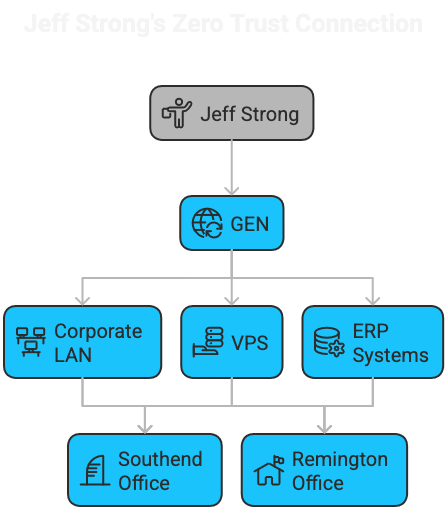
This service is a managed WireGuard network with an identity layer (Zitadel) and a policy layer. Instead of "connect = full network access", we design access around who the user is, what device they're on, and what they're trying to reach.
Good for
Contract
All plans
Zero Trust means we don't assume a device is trusted just because it's "on the VPN". Every access decision is treated as a new request to be evaluated.
WireGuard is a modern VPN protocol known for strong cryptography, small attack surface, and excellent performance. It's a great fit for always-on remote access.
Fully managed by specialists
This is not a self-service VPN kit. We design, configure, and manage the service for you, including more advanced requirements such as segmented access, policy rules, exit nodes, and hybrid cloud or on-prem routing.
Works over HTTPS-friendly paths
The platform can be deployed to use HTTPS-based connectivity, helping remote users connect securely from hotels, guest Wi-Fi, mobile networks, and other restrictive environments where traditional VPN traffic may be blocked or unreliable.
Exit Nodes
An Exit Node is a traffic routing node on your corporate LAN that handles VPN traffic between remote users and the internal resources they are allowed to reach.
This can be a single node for simpler environments, or multiple nodes deployed for load balancing, resilience, and failover.
All plans include one exit node. Additional exit nodes can be added for capacity, redundancy, failover, or to support different sites and network segments.
Routes
Routes decide which internal networks a user can reach over the VPN—for example a specific subnet containing file servers, a lab network, or a cloud VPC.
Policies & Groups
Policies define what is allowed. Groups keep management simple by applying those policies to a set of users (and optionally devices).
Micro-segmentation (Ports & Protocols)
Instead of "VPN gives you the whole network", we can allow only the specific ports needed. For example: SSH to a bastion, RDP to a jump host, or HTTPS to an internal app.
Posture checks
Posture checks are rules about the device's security state—used to allow, restrict, or block access. Typical checks include: OS version, disk encryption, endpoint protection, and device enrolment.
This is where zero trust becomes practical: a user can be valid, but access can still be limited if the device doesn't meet your baseline.
The same managed VPN platform can be shaped around very different access requirements, from tightly scoped application access to broader network connectivity.
Single RDP server access
A remote user can be granted access to one Windows server only, typically over RDP, without exposing the wider company network.
Proxied intranet access
Users can reach an internal web application or intranet through a controlled route or proxy path, rather than being placed broadly onto the LAN.
File server access
Remote users can be limited to one or more file resources, such as a single NAS share, departmental storage, or a defined set of internal file servers.
Full network or subnet access
Some roles need broader connectivity. Access can be granted to the entire company network or limited to a specific internal subnet such as a finance VLAN, lab, or cloud segment.
Internal API and microservice access
Developers, integrations, or support users can be allowed to reach specific internal APIs or microservices only, without access to unrelated hosts or ports.
Fixed Internet routing
Remote workers can have their internet-bound traffic routed so it originates from a fixed public IP, helping with SaaS allowlists, partner access controls, and consistent outbound identity.
GENAccess is a managed WireGuard/NetBird based VPN service. Pricing is £5 per user/month with one exit node included free. Additional exit/routing nodes are £10/month each.
| Plan | Users | Exit Nodes | SLA | Description | Monthly | |
|---|---|---|---|---|---|---|
| Single | 1 | 1 | SLA3 | Single user with included exit node | £5.00 | |
| Pack5 | 5 | 1 | SLA3 | 5 user pack with included exit node | £24.00 | |
| Pack10 | 10 | 1 | SLA4 | 10 user pack with included exit node | £47.00 | |
| Pack20 | 20 | 1 | SLA4 | 20 user pack with included exit node | £90.00 | |
| Pack50 | 50 | 1 | SLA5 | 50 user pack with included exit node | £215.00 | |
| Pack100 | 100 | 1 | SLA5 | 100 user pack with included exit node | £400.00 | |
| ExtraExitNode | 0 | 1 | SLA3 | Additional exit/routing node | £10.00 |
All plans include one exit node at no extra cost. Additional exit nodes are £10/month. 12-month contract, billed monthly. Larger deployments, resilient multi-node designs, or complex routing requirements may require a tailored design.
Want a quote or a quick design call?
Tell us how many users you have, where your apps live (on-prem, cloud, or both), and what you need to protect.