Subscribe to GEN
Login to GEN

GEN's story is one of being early. Sometimes we were exactly on time, and that gave us a catalogue of industry firsts. Sometimes we were too far ahead, building things the market was not yet ready for, and we paid for it. This page is both, told as honestly as we can tell it.
It begins with three people from three computer companies, and runs from EDI over X.25 to the data centres we run today. Much of what is described here is still in our possession, and a good deal of it still works.
We started as a team in 1985, three people who all had full-time jobs elsewhere: Richard Taylor at AlphaMicro, Ross Clarke at HP and Steve Smedley at DEC. By around 1987 we were working on EDI full time, for a single client. In 1989 we got our act together, left our other jobs and formed the partnership.
The timing was not an accident. DEC was in trouble, HP was not sure what it was doing, and AlphaMicro was running quickly into financial difficulty. Between them, our employers made the decision for us. We adopted Global Enterprise Network, the name of the EDI service we had launched that year, which ran over X.25 and then X.400 across private networks and PADs.
None of it turned out to be a false alarm. DEC, where Steve worked, went into a long decline and was bought by Compaq in 1998. AlphaMicro, Richard's employer, watched its market fall away as the PC took over, and within a few years had stopped making its own hardware and moved to PC-based systems. It was a time of giants that everyone thought were too big to fail, failing.
HP, where Ross worked, watched everyone around it falling apart and in 2002 bought Compaq. The merger was hugely controversial, thousands of jobs went, and many of us expected IBM to end up buying what was left. It never came to that. We genuinely did not expect HP to survive, but it did, and there is an irony in how it ended: through Compaq, Ross's old company came to own Steve's. Our own racks told the same story, as rows of HP LH4 servers replaced the DEC AlphaServers, and HP's enterprise business, Hewlett Packard Enterprise since 2015, is the hardware our data centres run on today.
As the internet arrived we changed Network to Networks, and in 1992 adopted GEN Professional to mark the new direction and to separate us from the domestic market amid the flurry of early ISPs, because we have always been strictly business to business. We are the UK's oldest business ISP, and over our 37 years we have worked with some of the biggest names in technology, past and present, and taken an active part in the UK's technological transformation.



Before the internet, we specialised in Electronic Data Interchange (EDI) over X.400 and X.25 on leased circuits. Our fastest link was 256k and data payloads were very small. We supported customers with mainframes and minicomputers such as AlphaMicro (AM100L, AM1000 and others), IBM (System/360, 370 and 390, Series/1, System/32, 34, 36 and 38), Prime (300 to 600, 750 and 850) and HP (1000, 3000 and 9000). It was a time of technology that now seems antiquated: VHS tapes for backup, RS232 terminals, modems, and point to point leased circuits, often called private wire because that is all you got, wire.
Whilst some of these systems were based on Unix, many were proprietary, and their different flavours, technologies and even character sets made interoperability tricky. We provided middleware together with connectivity, allowing cross-platform messaging and data interchange. EDI let companies automate order processing between themselves, such as one supplier requesting stock from another on a just-in-time basis driven by their ERP system, a job previously done by hand by a team of buyers working from printed reports. Early EDI was fraught with challenges, but the reward was significant, especially in larger supply chains such as automotive and retail.

In 1990, GEN was selected to provide the firmware for a series of communications satellites, interfacing flight control and microwave communications hardware with a computer system that could operate on its own but could also take commands from a ground station. It ran on Microware's OS-9000, a hard real-time operating system, on MIPS processors. For obvious reasons it had to be able to handle any eventuality, since even our most comprehensive service level agreements did not include site visits to orbit.
Redundancy went all the way down. There were three OS-9000 backplanes, three processors, three memory cards, three I/O cards and six power supplies. Two of the racks were duplicates in every way, right down to the code, and the third was the monitor, responsible for supervising the other two, with the ability to power up, power down, reboot and control each chassis individually. The main communications channel was in-band, but there was also an out-of-band antenna that could connect directly to the monitor at 300 baud if the downconverter ever failed. The satellite was designed to operate over a wide range of frequencies and protocols for 40 years, which for a satellite is a long time.
This was a military contract, and it is the reason there is so little to show for it here. No photographs, no source code and no documentation ever left the building, and staff were searched going in and coming out. We can tell you it flew and we can tell you how it was built, and that is as far as it goes. There is a particular discipline to writing code you will never be able to patch, for a customer who will never let you keep a copy of it, and it has shaped how we have approached engineering ever since.
It is nice to know that our software is still orbiting the planet, which also makes us the highest UK business service provider.
Our first data storage service, GEN Central Storage (GCS), launched in 1991 on Novell NetWare 3. Clients dialled in and managed their files through a simple interface, or by FTP or Gopher, long before anyone called it the cloud. It was text-based, with a back end written in sh and Perl, push and pull delivery scheduling, and terminal file access through a custom NCP to Zmodem converter. At the outset it carried mainly text files and early data files such as CSV.
Our first GCS customer was Radio Rentals. Their mainframe pushed the following day's service schedules, sales visits and collection appointments up to GCS overnight, and each engineer and representative dialled in the next morning to pull down the files allotted to them before hitting the road. It is worth pausing on that: a national field workforce collecting its work from central storage over a dial-up link, in 1991. The idea that your files live somewhere else and your people fetch what they need from wherever they happen to be is sold as a modern one, and we were doing it for a household name before most of the industry had a word for it.
GCS grew into a multi-server service and changed many times as internet speeds increased. It moved from NetWare 3 to NetWare 4, and some of it went on to NetWare 5, which was a disaster: flaky from the start. After that we did not know which way the industry would go, so we split it, some on FreeBSD, some on NetBSD, and some on early Linux, Slackware or Gentoo, possibly both. Yes, we know BSD is Unix. Linux won in the end, as it did almost everywhere.
In 1998 we partnered with Nokia to link our email service and GCS directly into their new 9000 series handsets, so companies could share files from the office with representatives in the field, and orders taken on the road could be pushed through GCS back into the client's fulfilment system. In 2008 we retired GCS in favour of newer services such as WebDAV and SFTP, and we still run cloud storage today, popular with our clients for data exchange and off-site backup.
GEN witnessed and contributed to the early internet, providing one of the first commercial dial-up internet services as business moved on from X.25, X.400 and bulletin board systems. Our first trial ran on eight Pace Nightingale modems and a 256k leased line from BT, connected to an IBM 5150 with an eight port RS232 card, which tells you something about the technology of the time. The trial was short-lived, and we quickly moved to E1 based dial-up and a 2Mbps circuit from BTNet.
At the time PIPEX was our only real competitor, and we enjoyed a friendly rivalry before the market exploded. The consumer providers that arrived alongside us, Demon among them, were serving an entirely different customer. We have never sold a domestic service in our history, and we have never wanted to: business connectivity and consumer connectivity are different disciplines, and trying to do both well has undone a good many providers since.

GENMail, our first email platform, launched in the early 90s and combined SMTP, FidoMail and X.400 in one system, the first and only platform to connect all three of the early messaging systems. Entry level services were free to small businesses, which did a great deal to bring them online and to popularise email. FidoMail and X.400 faded away, but GENMail carried on with rolling updates until 2015.
Its second release made GEN the first company to build PGP encryption into an email service, at a time when most people thought it unnecessary. PGP then went through a turbulent few years, sold on and pushed towards commercial licensing, before the world settled on GnuPG, which is what we use today. We still offer PGP encrypted email today, and use it ourselves: every email we send carries an independently verifiable PGP signature.
It is easy to forget how separate everything used to be. A typical business kept its email on one system, its diary on paper or in a desktop application that knew nothing about anyone else's, and its contacts in whichever of the two the person using them preferred, or more often in a card index. Booking a meeting meant ringing round to find out who was free. Shared contacts and calendars behind the same login as email were genuinely novel, and most of the market treated them as a luxury for large corporates with a Notes or Exchange budget to match. We added them to GENMail, and our 1996 advertising already listed groupware scheduling alongside email and a directory service.
We took the view that they should be standard, and made them so. GENZone, our enterprise platform, launched in 2012 alongside GENMail, and GENX, the second generation of our enterprise messaging, launched fully in 2016. Both shipped groupware on every mailbox, and GENX made it reachable from whatever the customer already used: POP3 and IMAP4 for the desktop, SMTP for anything that needed to send, a web client for staff away from their desk, Exchange access for offices committed to Outlook, and BlackBerry for the handsets that were, for years, how most people first read their mail away from the office. The uptake was swift. Once one department had a shared diary, the rest of the company wanted one within weeks, and the objection we heard most often was not the price but disbelief that it was included at all.
GENX was also one of our miscalculations. We built it for a mass migration from GENZone that never came: GENZone clients were, in their words, quite happy with the system as it was, and did not want the upheaval of moving. So GENX spent years in public beta and mostly took new clients, even though it was genuinely next level. It had instant messaging built in, on Jabber, later renamed XMPP, and tightly integrated with mail: mention an email in a chat and the client highlighted that very email, so "what do you think about this?" pointed straight at the message. We used it ourselves every day and were convinced everyone would want it. Enterprises at the time saw no value in instant messages at all. Today it is the first thing they ask for, and we provide it on Matrix.
GENZone was retired in 2022 and GENX in 2024, though in both cases almost every client had moved years before; there is always one who cannot be reached. The lesson of all three has stayed with us: people adopt something quickly when it is included, works with what they already have, and does not need explaining.
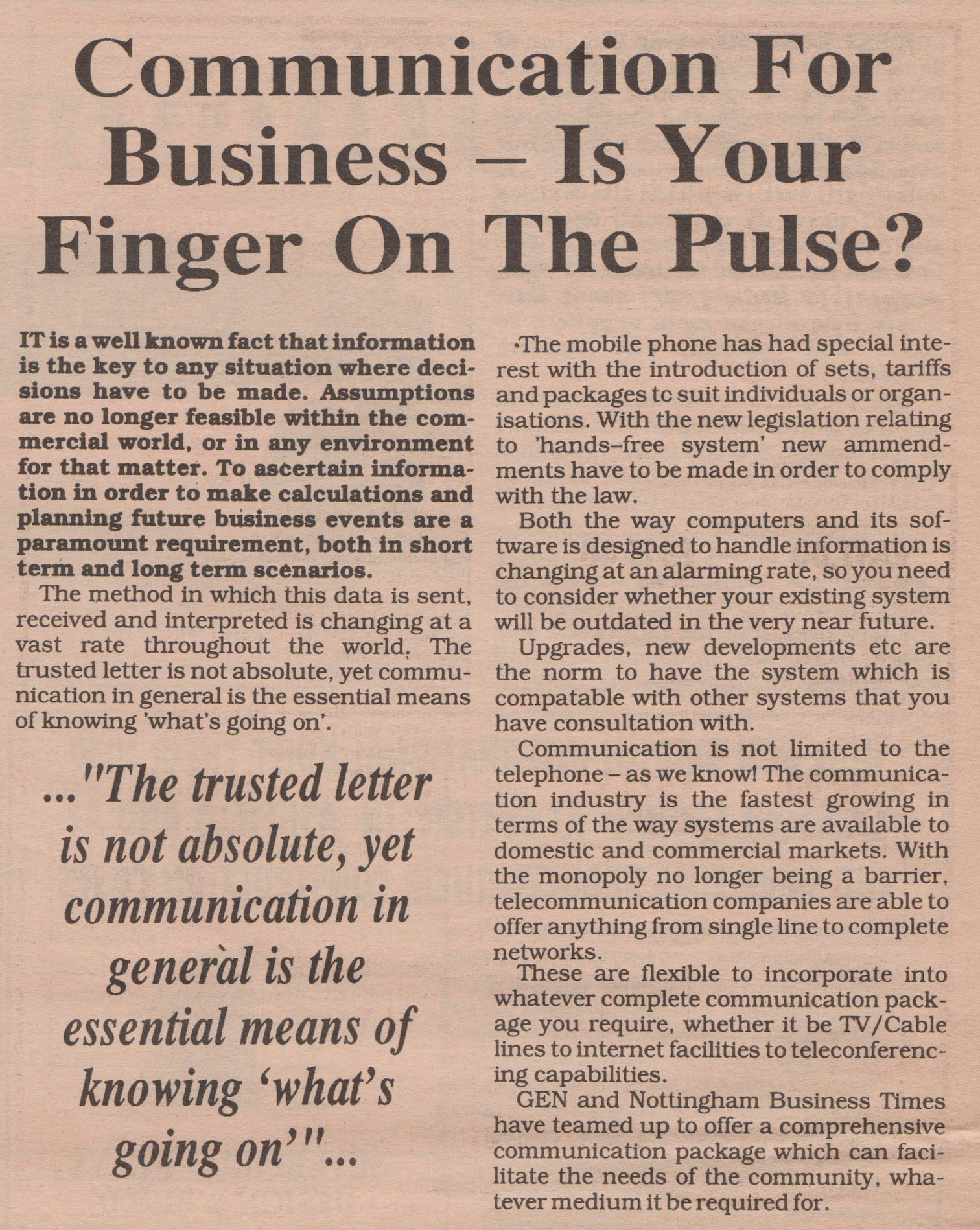
GEN played a real part in expanding internet connectivity in the UK, offering toll-free dial-up and 64k and 128k ISDN internet access long before BT Wholesale, and pioneering cellular modem access over BT Cellnet, in concert with BT.
We were an Intel Advanced Networking Partner from the 386 era, and somewhere there is still a plaque to prove it. We wrote BIOS code for early Intel network cards, deployed Intel's networking portfolio in our east coast data centre, including some of the very first layer 2-ish switches, and in 1997 and 1998, when Intel released its Express switches, we developed Intel Insight with them, an early forerunner of RMON.
GEN's first website hosting platform ran on two DEC AlphaServers and served HTTP/1 and very early HTML and SGML. A couple of years later we introduced early Microsoft hosting on Windows NT and HP LH4 servers. For a short time an OS/2 Warp web server ran in co-operation with IBM, but it was short-lived. With DEC's financial troubles we expanded hosting onto Sun Microsystems and Solaris, and finally migrated again to early Linux.
The rest of our estate went the same way. For years we ran almost entirely on DEC Alpha, and then Compaq Alpha, until the move to Intel Xeon on HP LH4s, which was quite a culture change. It was the age of Windows server, though we did not stay on it long before moving to Linux. Alongside it ran Solaris on Sun hardware, Cobalt RaQ appliances, Ferranti hardware, Intel servers and IBM 6150s running AIX. That mix was deliberate. Every month some new computer company appeared promising something new, and at a time when the giants were failing, the safest course was never to put all our eggs in one basket and always to keep our options open. It is the same reason we split GEN Central Storage across FreeBSD, NetBSD and Linux, and why we still choose our partnerships so carefully today.
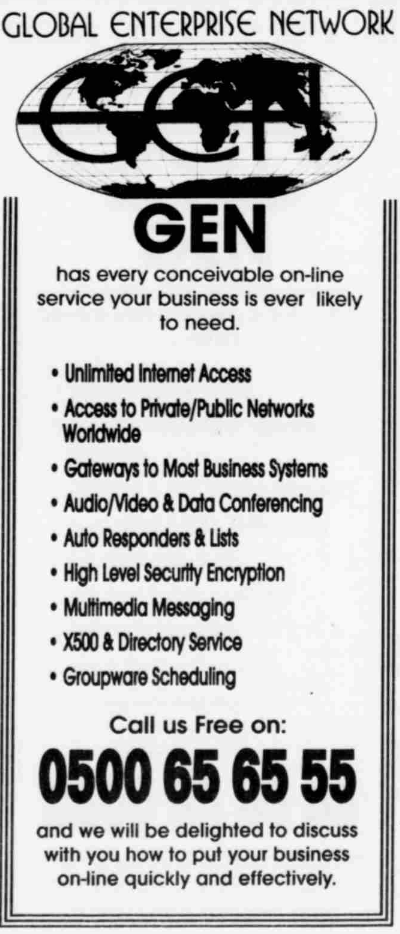
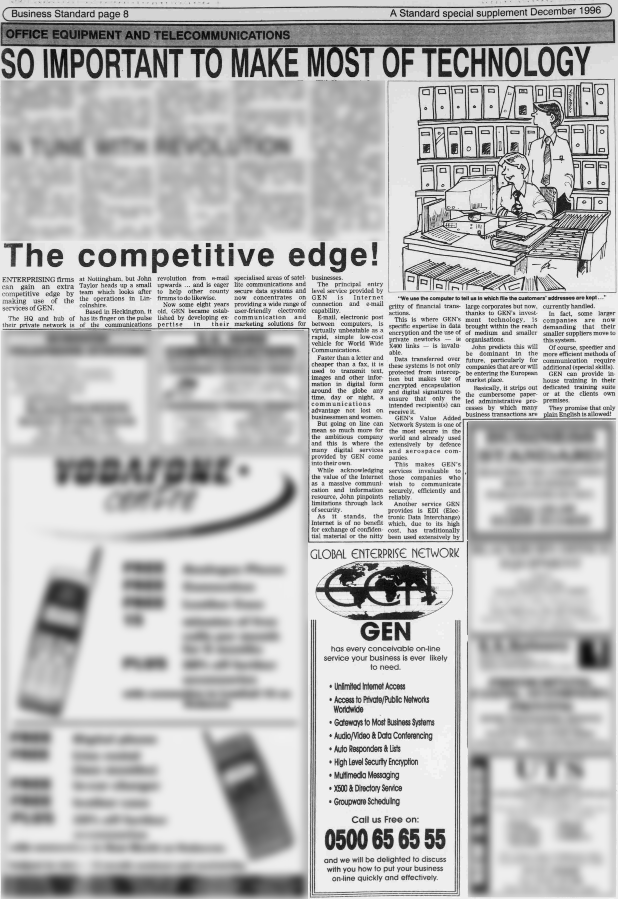
Our advertisement in the Sleaford Standard on 28 November 1996 shows how extensive the portfolio already was: gateways to most business systems, audio, video and data conferencing, groupware scheduling, a directory service, and high level security encryption long before anyone else thought they needed it. The full page is available on request. The directory service, long before Microsoft's Active Directory, gave users single sign-on across our internet, email, GCS and other systems, and was unique in the industry at the time. We also had interconnects to networks not yet on the internet, such as BLAISE, the British Library's online service, and JANET, the Joint Academic Network, which our dial-in users could reach.
In April 1997 we ran NETPAK in the Nottinghamshire Business Times, an all-in-one package for small businesses: a professionally designed web page hosted for a year, an ultra high speed 33,600 bps modem (a Hayes Accura, if memory serves, not any old modem), unlimited internet access, up to five email addresses, no connection charge, the first month free and 24 hour support, all for £149.95 including VAT and a flat £10 a month. That was disruptive at the time, and we made a loss on it in the first year, but this was the decade of the land grab for connectivity customers, and most of our competitors were only selling internet access.
Around the same time GEN was involved in developing VideoLink, one of the first video conferencing systems available commercially over IP. It came long before Cisco and Polycom, but the company behind it never had the teeth to take it mainstream.

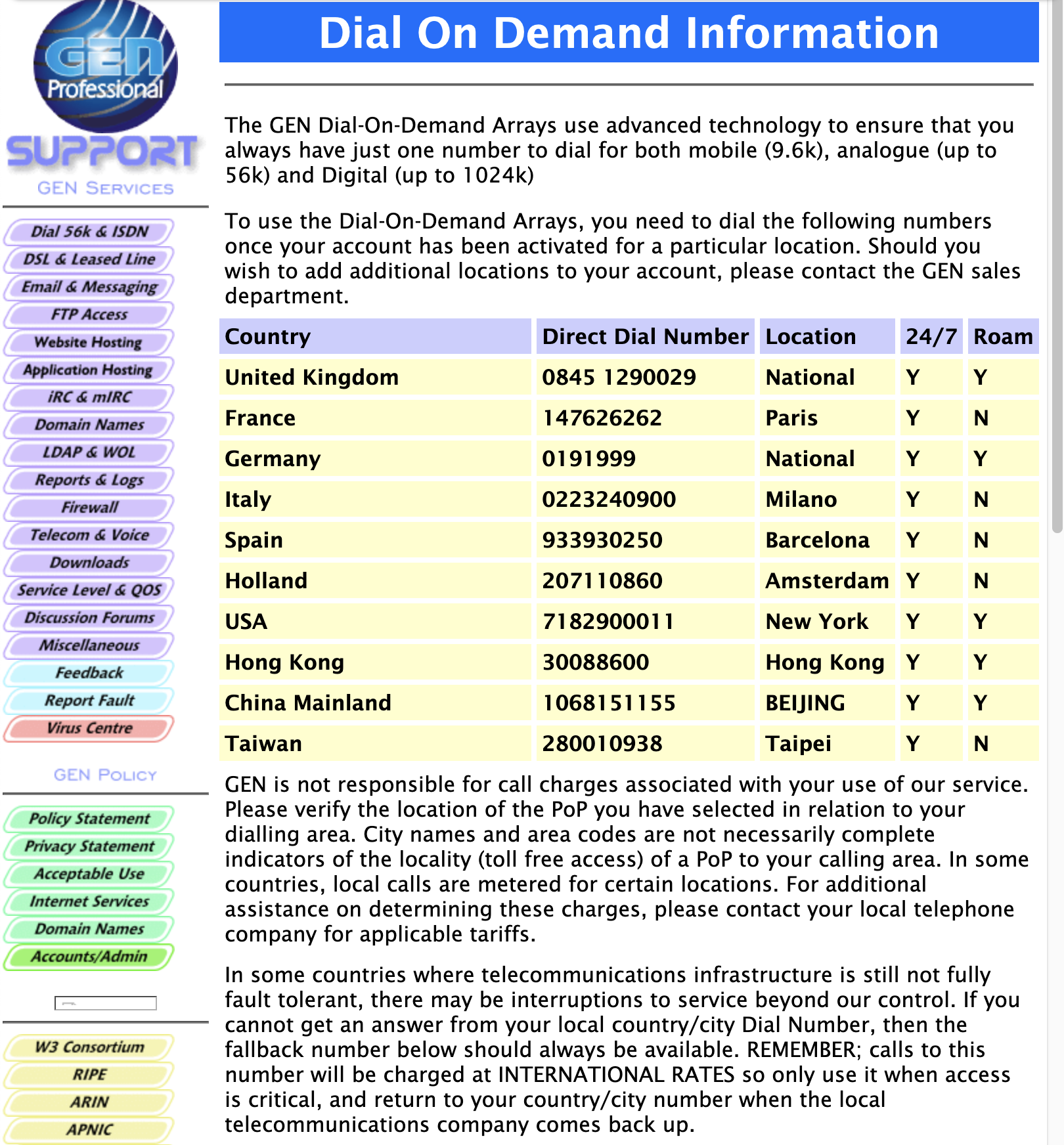
As dial-up exploded, GEN sourced Hayes Century remote access platforms for high density connectivity, running on early Windows NT 4.0 while we still had systems on NT 3.51. Each rack supported one E1 circuit and 30 channels, 30 analogue dial-in or 15 bonded ISDN2, and we started with eight of them for 240 simultaneous connections. As the market grew, so did we, to 80 units in total, making GEN the largest operator of Hayes Century equipment in the world, with dial-up points of presence in ten countries.
GEN was the first company to offer bonded ISDN2 circuits for aggregating bandwidth over digital dial-up. Each channel was 64k, and each NTU could bond two channels for 128k. Our Office Gateway could handle up to eight ISDN2 devices, for a maximum of 512k. In its early form it was a PC with a number of serial modems and ISDN devices, running a caching proxy server on Windows NT with a smart disk cache and an on-demand scaler that measured network demand and brought more circuits up as they were needed, again a first in the industry. It ran right through to the late 2000s, when routers took over from computers. We no longer need the scaler or the cache, and we no longer call it Office Gateway, but the offering is the same today: multi-path internet access on a smart multi-WAN router, load balanced or in a primary and standby arrangement.
When GEN introduced toll-free dial-in on the Diamond Cable network, customers could keep channels up around the clock at no cost, a year before toll-free dial-up arrived in the rest of the UK. For customers outside the Diamond Cable area we negotiated a deal with Affinity for an ingress cost of 1p a minute, unheard of at the time, which let businesses connect at a fixed £100 a month, very keen for 64k access.
By the time BT Wholesale dial-up became a thing, businesses needed more bandwidth than 56k, 64k or even 512k, and private circuits had become far more sensibly priced. GEN partnered with BTnet to deliver those fast, relatively speaking, connections from 64k up to 10Mbit, before the arrival of DSL.
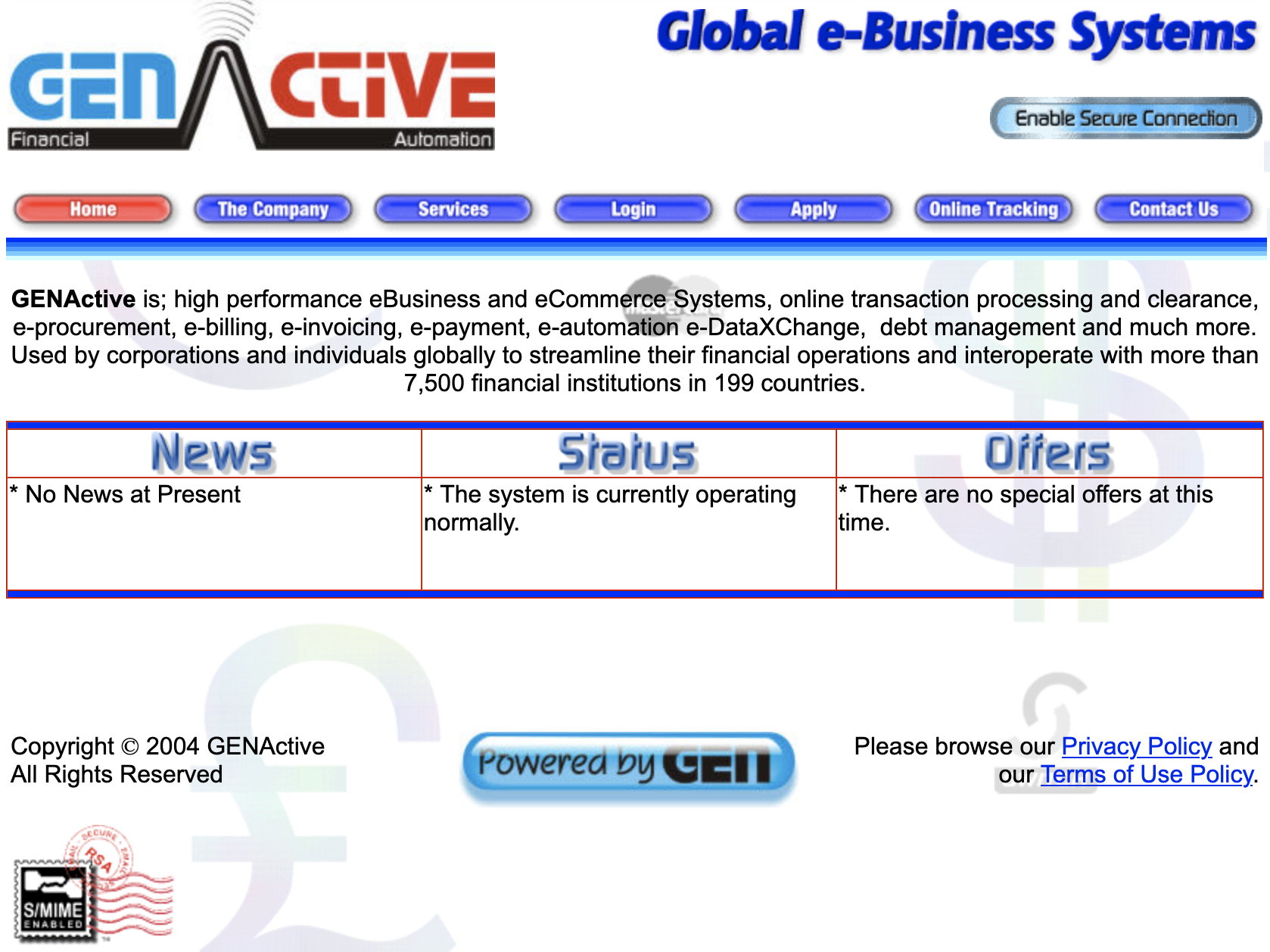
By the end of 1999 the internet was firmly established, and online payment was in its infancy. GEN invested a considerable sum in GENActive, an online payment platform that integrated with banks to move money between companies over the internet. A GENActive account holder could pay for a product or service and GEN handled the transaction, whether by credit card, bank transfer or cheque. Yes, it handled cheques.
By 2004 it was working with more than 7,500 financial institutions in 199 countries. Unfortunately PayPal and Nochex were entering the market at the same time and quickly took the share, but the platform carried on handling payments for our clients until 2011, when GEN's internal CRM systems were replaced.
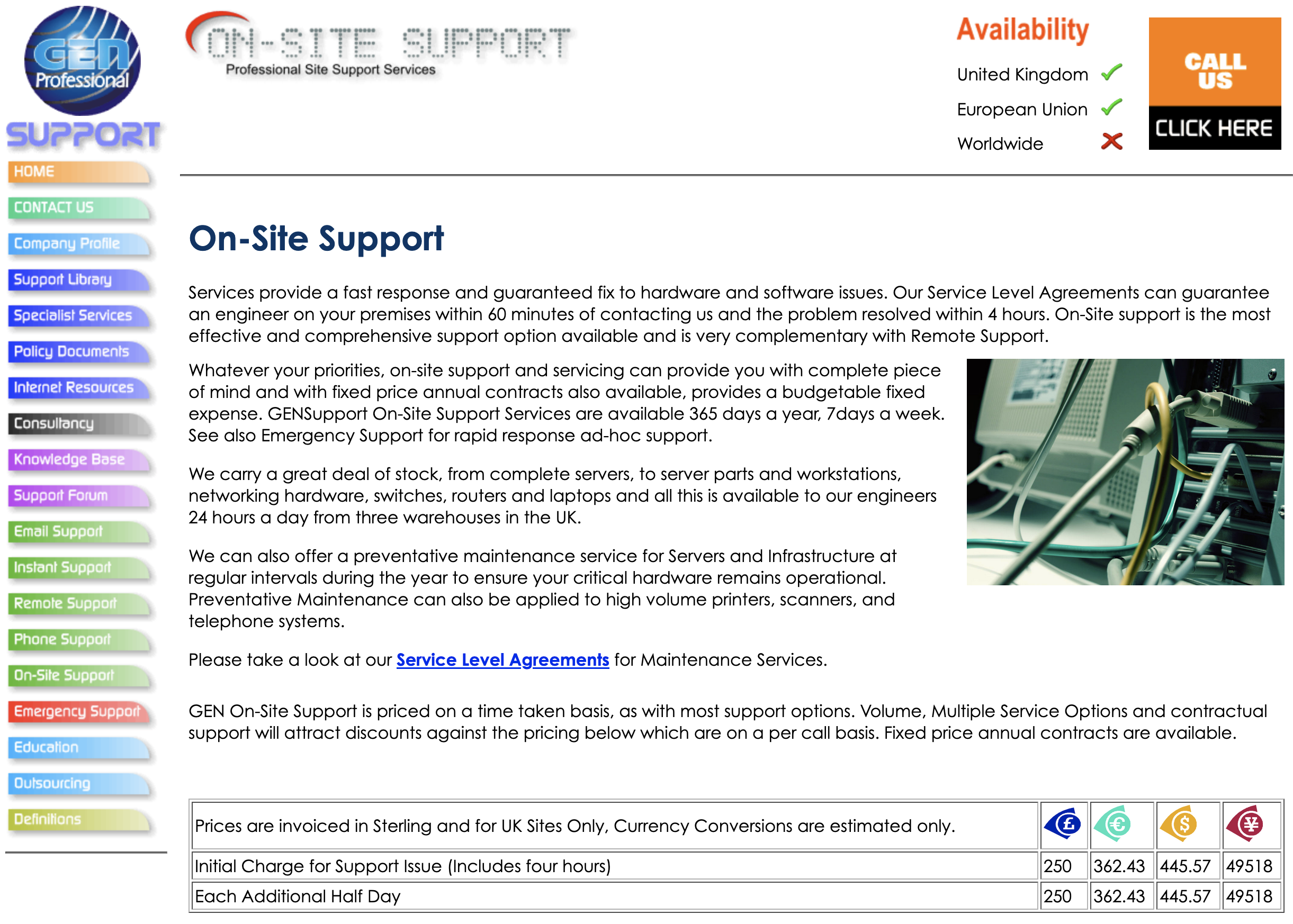
At the end of 2000 GEN bought KCL, an IBM hardware maintenance company, and merged its hardware support into a newly formed company, GENSupport, which took on all the staff and maintenance contracts. The thinking at the time was that hardware maintenance was a separate channel and should be managed as one, while the core business was an ISP.
Six years later it was clear the separation had been a mistake. Disputes about whose fault a call-out was, GEN's for connectivity and systems or GENSupport's for hardware, had become a major distraction, and after several restructures the subsidiary was merged back into the main business. We still run our service and maintenance business under the GENSupport name, because it had, and still has, a strong reputation for delivery.

At the end of 2001 GEN acquired Delta Security, a national alarm installer, intending to lead what was then a small trend in very early building automation, automatic lighting, heating and the like, and to combine it and alarm monitoring with GEN's connectivity. The company ran for nine years, until 2010, when it was sold on, mostly because it was not profitable: the smart building did not take shape as predicted, or at least not in time for us.
Long before Amazon's AWS and Microsoft's Azure, GEN was offering cloud computing, in 2001. Our first platform was built on VMware's GSX Server, on Pentium II and III servers, and from memory one Xeon NetServer, maybe an LH4. Our first virtualisation customer was a company called NExt, who hosted a number of Windows virtual machines.
GSX was a very early type 2 hypervisor, tragically slow and fraught with technical issues, but VMware were quick to release ESX, their first type 1 hypervisor, later that year, and it was a huge step forward in both performance and reliability. We stayed in the VMware ecosystem until 2024, when the sale of VMware to Broadcom made a move to the KVM hypervisor necessary, and today our private cloud runs on it.
By 2010, IT maintenance had settled into a shape that suited everybody except the customer. Support was sold fixed price and multi-year, three years or five, and the commercial logic behind it was bid low, win the account, then find the money later. Agreements were drafted with that second step already in mind: the exclusions, the carve-outs and the careful definitions of what did not count as covered work were where the profit lived, because the price that won the tender was never going to produce any on its own. The client signed for certainty and received a document engineered to produce surprises.
We never worked that way, and we still took business from the firms that did, because we offered something none of them would match. New clients got their first month free. The reasoning was not complicated: nobody should be asked to commit to five years of anything without sampling the merchandise first. It cost us a month of labour on every prospect, and it won us more accounts than any tender we ever entered, largely because the incumbent could not answer it without explaining why they would rather not. It did not make us popular with our competitors.
The deeper problem was the pricing itself, and we knew it because we were doing it too. Quoting a fixed price contract meant working out roughly how many hours a year an estate might need, doubling it, adding something for the things that had not occurred to us, and presenting the result as a price. We had a system to estimate it. So did everyone else. Every one of them produced a confident figure from a foundation of guesswork, and the client paid that figure whether the year turned out quiet or brutal.
It is worth asking why IT alone worked this way. Your solicitor does not sell you five years of legal cover at a fixed monthly fee. You place a sum on account and draw against it as you need it. Your accountant is the same, so is your architect, so is very nearly every professional service anybody buys. Only IT support insisted on the fixed, multi-year model, and it is not there for any good reason. It is inherited, more or less directly, from the way IBM sold maintenance on machines that cost more than the building they stood in.
So in 2010 we stopped. The contracts went, the fixed prices went, and the annual renewal dance went with them. What replaced it is the arrangement we still run today: here are our rates, choose the service level you want, buy a block of hours, and use them as you need them. Anything you do not use carries over. Nothing expires because a date has passed.
Sixteen years on, the multi-year fixed price contract is still being pushed across our industry, clients are still signing them, and we still do not really understand why. Our position has not moved. Buy a hundred hours, use a hundred hours, buy another hundred if you want them. If you would rather go elsewhere, go, at any time, with no termination clause to negotiate your way out of. We can afford to offer that because clients do not leave, and they do not leave because the service is worth staying for. A firm that needs five years of your signature to keep you is telling you something about its service, and about the invoices you have not seen yet.
How we work with clients today is set out in our engagement model.
Much of what is described above is still in our possession. We kept the machines we ran and the machines our clients ran, from AlphaMicro, DEC and HP minis through to the Hayes racks that carried the dial-up network, and a good deal of it still works. We threw away far more than we saved, usually because it was taking up space a rack needed, and we have regretted most of those decisions since.
The full collection is catalogued in the GEN Museum, and our archive of software, source code and manuals is on the GEN WIKI. If you are restoring something of this vintage, or you are a museum wanting to borrow a piece for an exhibition, do get in touch.
When we first started, everything was moving so fast that not a day went by without some new computer company launching with the very latest this or that, and we had to invest constantly to stay relevant. There was never a dull day, and our hardware turnover was massive. We witnessed so much: the collapse of DEC, the rise and fall of Sun, the failure of Prime, Alpha and ICL, and of course the growth of Unix and then Linux as the number one platform. I remember customers with paper tape readers and magtape. We had one customer running an IBM Series/1, and when it crashed you had to feed a box of punched cards into a reader to boot it. Those were the days, when a hardware fault usually involved a small fire. And do you remember when Microsoft thought the internet would never catch on, and launched MSN as the right way to do it?
The last 20 years have seen GEN evolve from an ISP into a full service IT company, from connectivity to cloud storage, hosting and security. We have made mistakes over the years, sometimes investing in the wrong technology, and sometimes in the right technology too early, but who has not? We have survived, and grown stronger because of it. Staying a partnership has let us decide our direction quickly and make rapid course corrections when they were needed.
There is a harder edged reason for it too, and a great deal of work has come to us on the strength of it. A limited company is a separate legal person, and when one fails its debts stop there: the people who ran it can wind it up, walk away from what they owe, and be trading again the following month behind a new name. That pattern was common in IT when we started and it is no less common now. A partnership offers no such shelter. The partners are jointly and severally liable for what the firm commits to, so when we take on a project it is our own money standing behind it, not a balance sheet that can be closed down when the work goes badly. Clients have told us for years that this was the deciding factor when they had something critical to place, and we would rather be judged on that than on a logo.
We have continued to innovate and adapt to the changing landscape of technology, and we are proud to have been part of the UK's IT industry for 37 years. Things have certainly stabilised over the last decade, with connectivity and virtualisation now mainstream services we build others on. AI is an evolving landscape, and of course we are investing in that too, but you should not believe all the crazy claims in the media. The future is certainly bright, and we very much look forward to it, even on a Monday.

If any of this sounds like the sort of firm you would rather deal with, we would be glad to hear from you. The people in this story are the people who still run GEN, and they still answer for it. What we do today is on our About page.